The 2026 market edition

Buy your first home in the market that actually exists.

A practical, step-by-step guide for buying when rates are high, affordability is tight, and the old rules no longer apply.

Get the Playbook, $XX
Instant PDF download. Read on any device.

Built from sources like

  • Freddie Mac
  • Fannie Mae
  • Mortgage Bankers Association
  • CFPB
  • VA
  • NAR

Rates and rules are current.

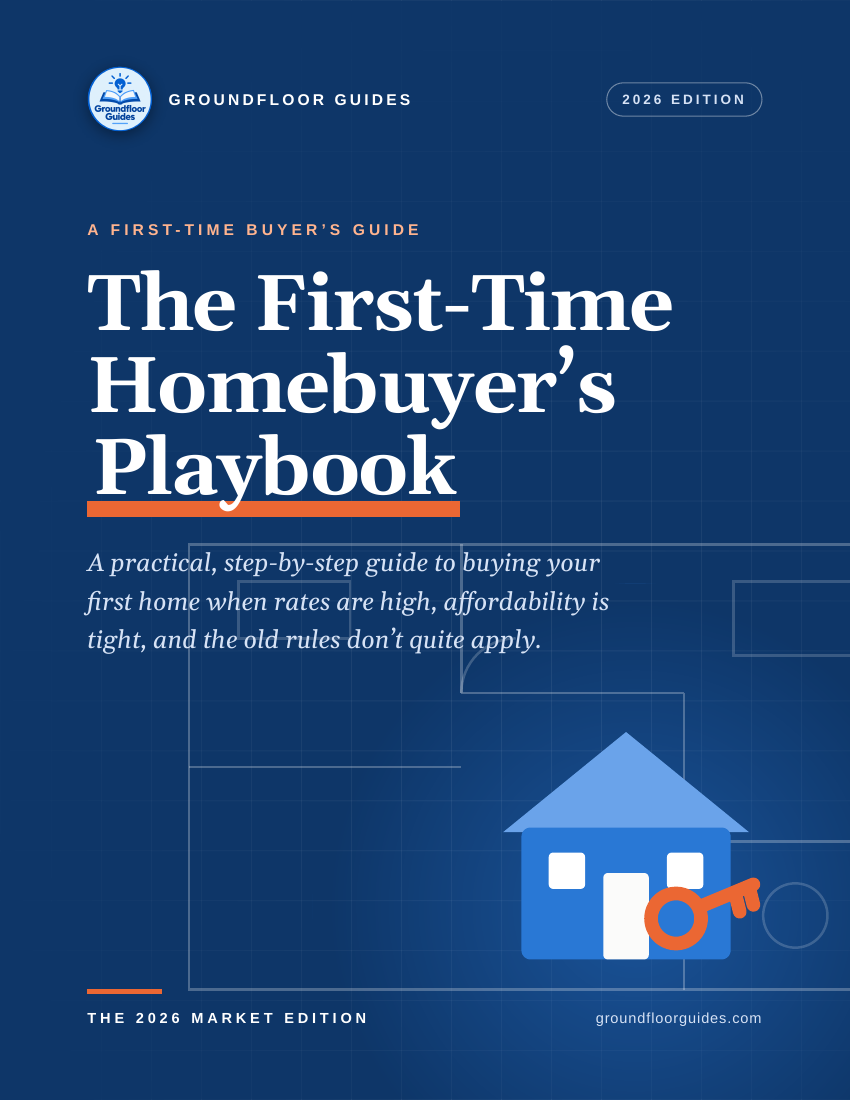
Cover of The First-Time Homebuyer's Playbook, with a blue house and an orange key
59pages
21chapters
10charts and diagrams
PDFinstant download

The problem

Most homebuying advice was written for a different market.

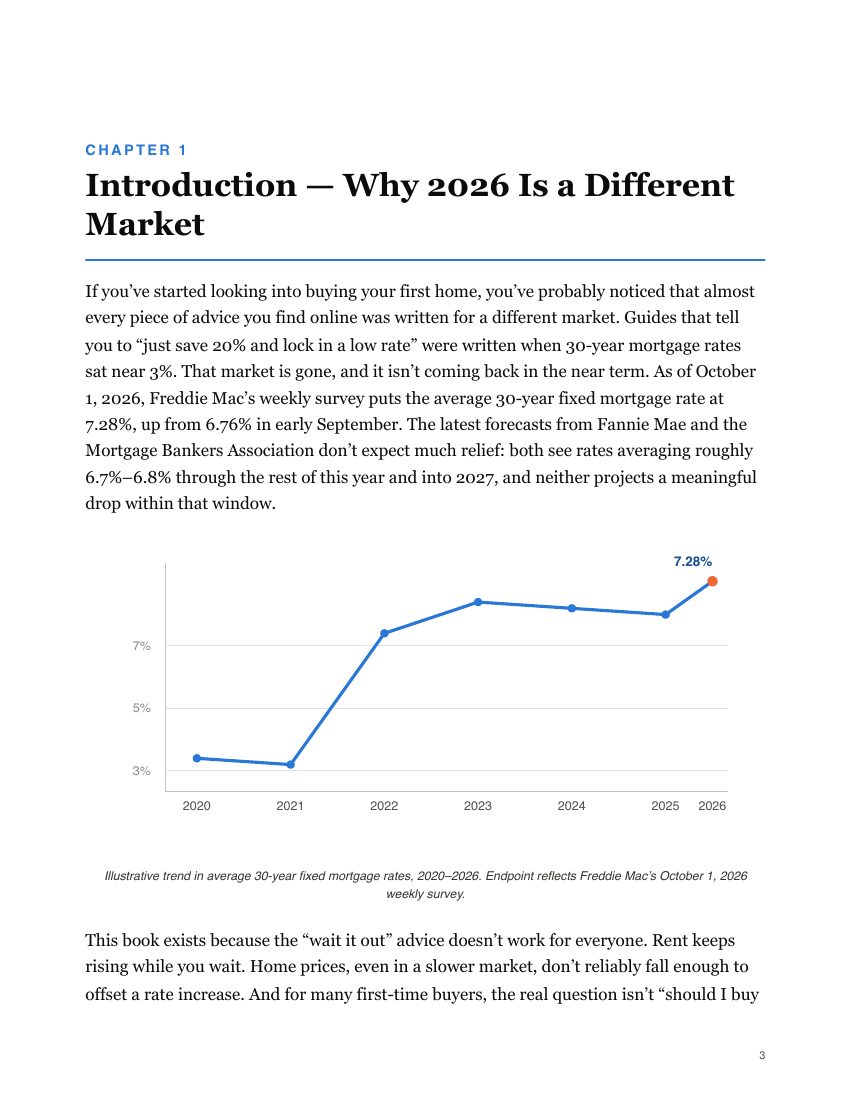
3%The mortgage rate when "just save 20% and lock in a low rate" was good advice.
7.28%Freddie Mac's 30-year fixed average at the time of writing.

That old market is gone for now. Rent keeps rising while you wait, and waiting for the perfect rate is a bet you cannot time.

You cannot control rates. You can control your credit profile, your loan type, your down payment strategy, the strength of your offer, and how well you negotiate. This playbook walks through each one in the order you will actually need it.

See what the rate does to a payment

Slide the loan size and the rate. Then see how the book helps you close the gap.

At 3.00%
$1,476
At 7.28%
$2,395
That is $919 more every month, or $11,030 a year, for the same loan.
Monthly principal and interest on a 30-year fixed loan. Taxes, insurance, and mortgage insurance are extra. 7.28% is the Freddie Mac average at the time of writing.

Real numbers, worked through

The book doesn't stop at rules of thumb. It runs the math on realistic examples so you can repeat it with your own figures.

The 28/36 rule on a real income

$100,000 a year

The 28% ceiling caps your housing payment near $2,333 a month. At about 7.3%, that typically supports a $335,000 to $380,000 home with 20% down. Then the book shows why two households with the same approval can feel very different once take-home pay and existing debt are counted.

A 2-1 buydown, payment by payment

$1,879 → $2,098 → $2,329

On a $350,000 loan at a 7.00% note rate, that is your monthly payment in year one, year two, and from year three on. The book explains why sellers offer this instead of a price cut, and how to ask for it.

Are discount points worth it?

About 59 months

On a $400,000 loan, one point costs $4,000 and saves about $68 a month, so it takes just under five years to pay for itself. You get the formula to test it on your own loan before you pay.

What closing really costs

$7,000 to $17,500

Closing costs run roughly 2% to 5% of the loan, and they come on top of your down payment. The book itemizes each line, from title insurance to prepaid taxes, so nothing surprises you.

Plus the worksheets and checklists you will reuse

  • CH 3Six-months-out financial readiness checklist
  • CH 7Lender comparison sheet
  • CH 9Must-haves vs. nice-to-haves worksheet
  • CH 15Year-one homeowner budget
  • CH 17Month-by-month roadmap, from 12 months out to closing and beyond
  • CH 19, 20Frequently asked questions and a plain-language glossary

Examples use the figures and rates in the book, which are current.

What you will be able to do after reading it

01

Know your real number

Budget against your take-home pay, not just the maximum a lender will approve.

02

Skip the 20% myth

See how low-down-payment loans and down payment assistance programs actually work.

03

Pick the right loan

Conventional, FHA, VA, and USDA compared side by side with a simple decision framework.

04

Shop lenders and save

Compare APR, not just rate, and learn when points and rate locks are worth it.

05

Make a smarter offer

Strengthen your offer without overpaying, and ask for buydowns and credits instead of price cuts.

06

Avoid costly surprises

Wire fraud, closing costs, and year-two escrow shock, explained before they reach you.

A look inside

Three real pages from the book, exactly as you will read them.

Chapter 1 page showing a line chart of 30-year mortgage rates from 2020 to 2026
Chapter 1: why this market is different, with the rate trend.
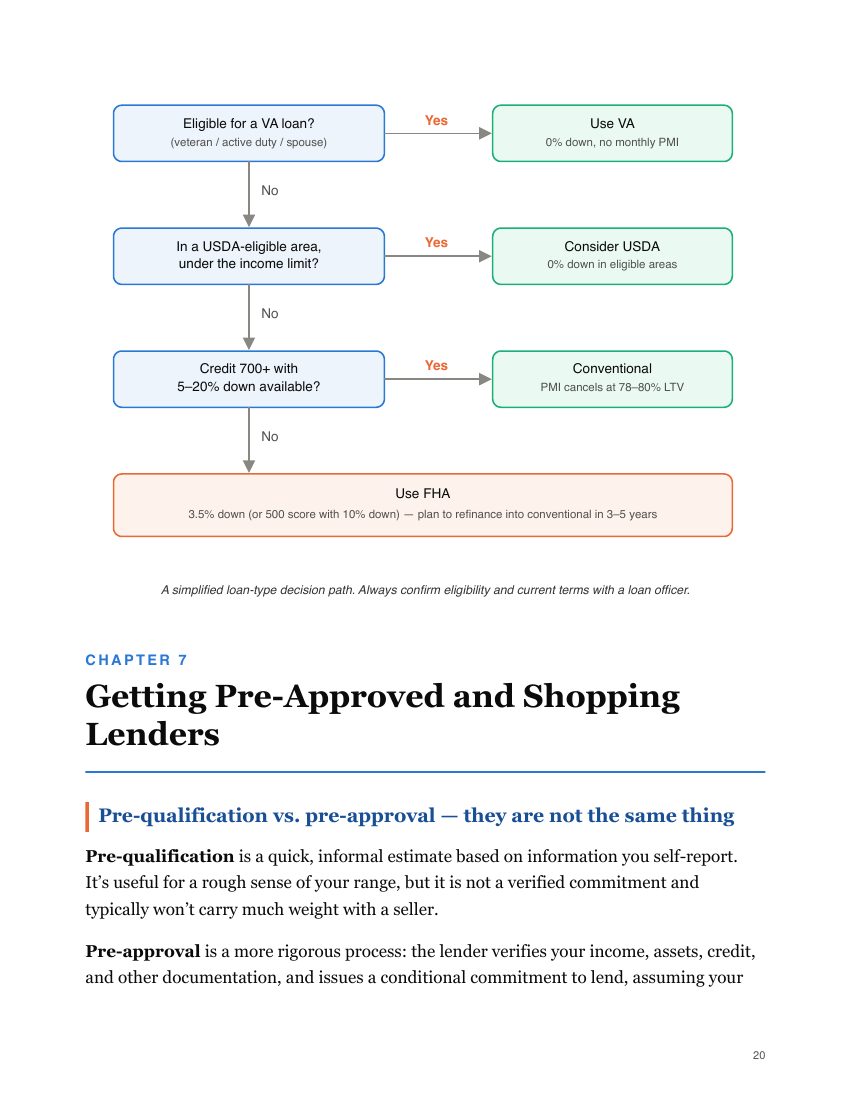
A decision tree that helps a buyer choose between VA, USDA, conventional, and FHA loans
Chapter 6: a simple path to the right loan type.
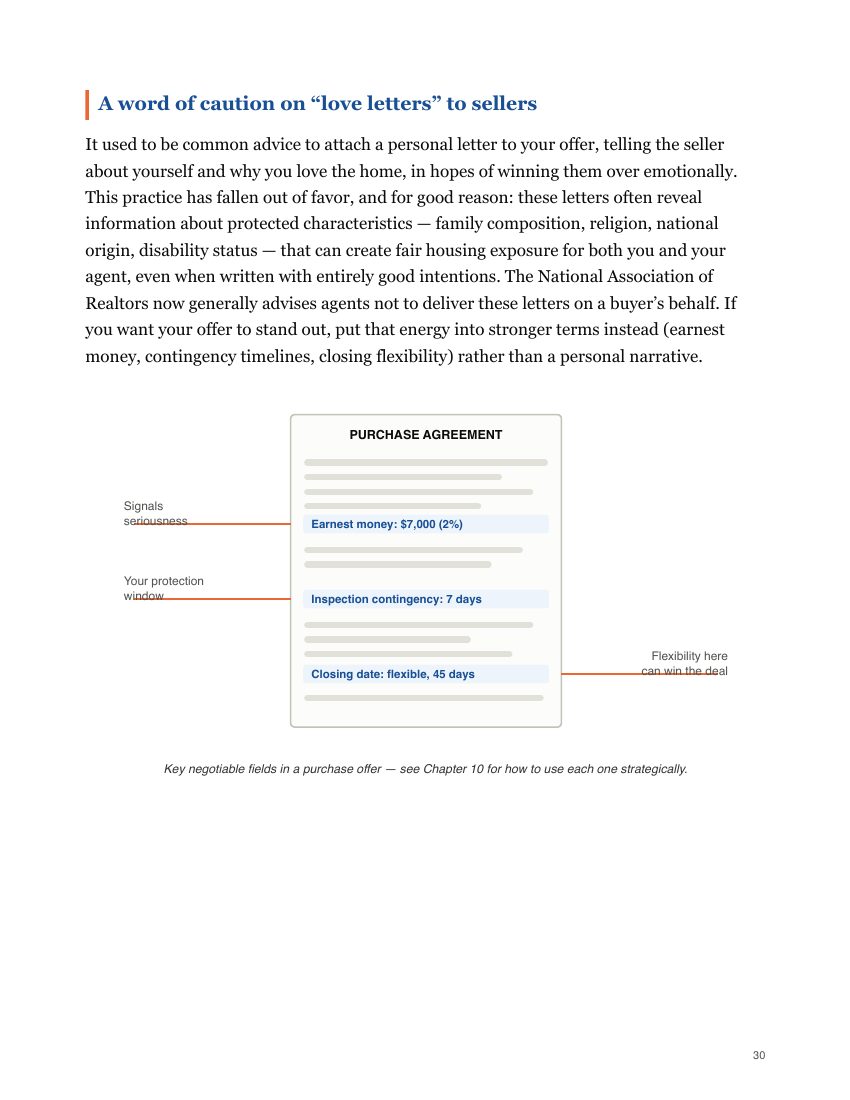
An annotated sample purchase agreement pointing out earnest money, contingencies, and the closing date
Chapter 10: the offer terms you can actually negotiate.

Your roadmap, start to finish

Twenty-one chapters, ordered the way a real purchase unfolds, from getting your finances ready to your first year as an owner.

  1. 1

    Get your bearings

    Chapters 1 to 2

    Why 2026 Is a Different Market · Understanding Today's Mortgage Rate Environment

  2. 2

    Get your money ready

    Chapters 3 to 7

    Getting Your Finances Ready · How Much House Can You Actually Afford · Down Payments: Rethinking the 20% Myth · Loan Types Compared: Conventional, FHA, VA, USDA · Getting Pre-Approved and Shopping Lenders

  3. 3

    Find it and win it

    Chapters 8 to 12

    Building Your Team: Agent, Lender, Attorney, Inspector · House Hunting Strategy in a High-Rate Market · Making a Competitive Offer Without Overpaying · Rate Buydowns and Seller Concessions · New Construction vs. Resale vs. Condo

  4. 4

    Inspect, appraise, close

    Chapters 13 to 14

    The Inspection and Appraisal Process · Navigating Closing: Costs, Timeline, Paperwork

  5. 5

    Own it well

    Chapters 15 to 18

    After You Close: Budgeting, PMI, Insurance, Refinancing · Common First-Time Buyer Mistakes to Avoid · Your First-Year Timeline: A Month-by-Month Roadmap · Special Buyer Situations

  6. 6

    Keep it handy

    Chapters 19 to 21

    Frequently Asked Questions · Glossary of Terms · Sources and Further Reading

Where the information comes from

You shouldn't have to take a stranger's word for any of this. The book ends with a source list of about 50 references, grouped by topic, so you can find the original behind each chapter and check it yourself.

Official and primary sources

  • Freddie Mac: the weekly Primary Mortgage Market Survey, and its research on how much borrowers save by shopping lenders
  • Fannie Mae: its Housing Forecast
  • Mortgage Bankers Association: its rate forecast
  • Consumer Financial Protection Bureau: when mortgage insurance can be removed
  • U.S. Department of Veterans Affairs: the VA funding fee
  • National Association of Realtors: the mortgage interest deduction, and guidance on buyer letters
  • Clever Real Estate: its 2023 American Home Buyer and Seller Report, a company survey, labeled as one in the book

Consumer finance and industry publications

Bankrate, Rocket Mortgage, The Mortgage Reports, Experian, Redfin, Zillow, CNBC, Better.com, and others. The book uses them for typical costs, how loan programs work, and plain-language explanations.

Where a number depends on your state, lender, or credit, the book says so and points you to your lender or state housing agency instead of giving you a false average.

How it was checked

  • The 2026 conforming and FHA loan limits were confirmed against published 2026 announcements.
  • The mortgage rate and the Fannie Mae and MBA forecasts were refreshed just before publication and checked against their reporting.
  • Freddie Mac's savings figures were checked against its own research note.
  • Surveys are named, with the year.
  • Statistics that could not be confirmed were removed, not rounded into something that sounded right.

Dated, and honest about it

Rates and rules change. The book dates its numbers wherever they can go out of date. It is general education and not advice, so it tells you what to confirm with a lender.

Independent, and open to corrections

Groundfloor Guides is an independent publisher. We take no referral fees from lenders, agents, or brokerages. If you find a mistake, email contact@groundfloorguides.com and we will correct the guide.

Written for you if

You are a first-time buyer in the United States, or a renter deciding whether buying makes sense right now. You want the real tradeoffs in plain language, not a sales pitch for a particular lender.

Worth knowing first

The book covers U.S. loan programs and rules. It is general education, not financial, legal, or tax advice, and rates and program details change, so confirm current numbers with a lender before you decide.

Get the playbook before you make an offer.

One download, 59 pages, yours to keep and reread at every stage of the purchase.

Get the Playbook, $XX Instant PDF download. Secure checkout.